Archive
Bleach 394
Extinguir is still a stupid name, and it still just looks like a stand.
White backgrounds! Speed lines!
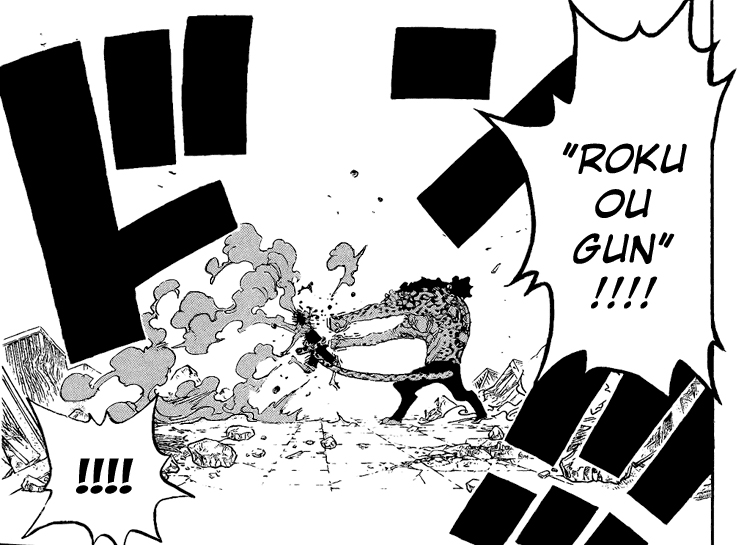
Hmm, Sokotsu Domination looks familiar. Compare Bleach 394 (March 2010):
 … with One Piece 427 (September 2006):
Final Flash: Yet another irrelevant non-Ichigo fight. Boring.
History of Shonen Addendum
For those of you who came tonight: Thank you! I’m very pleased with how the event went overall, and by the size of the crowd. I’m somewhat amazed that I was able to speak for nearly five hours, but time seemed to fly by (at least, to me), so I hope it was as entertaining for all of you as it was for me. I loved the casual atmosphere, and I was completely flattered that non-regulars to anime club actually came to watch me. Thank you so much.
The series list I promised is right here:
Series in bold are an arbitrary declaration of the more important titles, and are a decent indication of series to read in terms of overall relevance (not necessarily quality).
I must ask that no one use the list for any purpose other than personal enjoyment or reference without my permission.
—
I also want to briefly elaborate on a claim I made a few times about some series, which may be hard to understand without proper explanation. I mentioned how some series are able to do comedy brilliantly well, but then feature uncharacteristically heartfelt chapters which were done very effectively. A perfect example:
How to set up and deliver a punchline: Gintama 171
How to charm your readers: Gintama 172
The effect is only strengthened by the fact that these chapters are back-to-back. The non-comedy chapters of Sket Dance achieve a similar effect.
—
For the record, I wholeheartedly recommend changing your online manga reader to MangaToshokan. Uncompressed images and a clean website layout make it markedly better than OneManga or MangaFox, which I only use for anything not yet uploaded to MT.
—
If you’ve been inspired to discover new series, and are pleased with what you find, please let me know! I’m curious to know how well-received my recommendations are.
Medaka Box Vomic
As a followup to the recent post regarding Medaka Box, here is the recently-released vomic (officially-made manga with voice acting).
Medaka Box Steadily Improving
After uninspiring beginnings which have placed it in danger of cancellation for months, Medaka Box is finally starting to find some direction in its plot and character development.
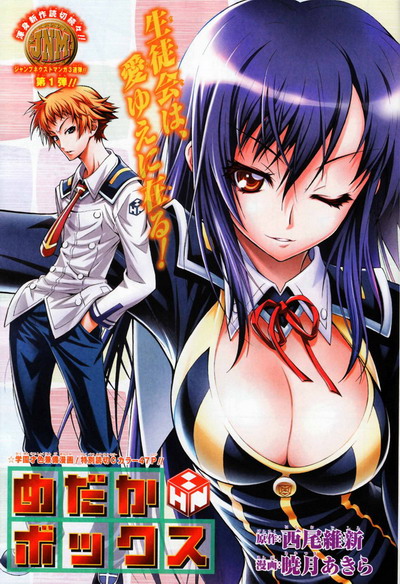 The series follows first-year student Medaka Kurokami (pictured, right), the newly-elected student council president, who is impossibly near-perfect in every area, including academics, athletics, and looks. She sets up a suggestion box in hopes of helping students in need and improving the school. She is joined by her childhood friend, the comparatively normal Zenkichi Hitoyoshi (pictured, left), who does not wish to join the student council, but does want to stay close to Medaka.
The problem with Medaka Box has never been the characters. Medaka complements her excellent mental and physical traits with a strong personality, which generally presents itself in humorous ways. One recurring scenario is for her to stand immediately behind someone and exactly mimic their pose (example). Zenkichi is the closest the series has to a comedic straight man, and is the only character with which the audience has a chance to relate. The secondary characters are all diverse and interesting, though some of their traits feel forced, as though the author is trying to make each new introduction live up to the absurdity of Medaka.
Instead, the problem Medaka Box faced upon its debut was the similarity of its plot template to existing series. The core concept of Medaka, that a small group undertakes tasks to assist whoever asks, was already shared by two currently-running series in the same magazine: Gintama and Sket Dance. Granted, there are some notable differences; Gintama mostly uses this format as a device to launch other, more involved plots (whether gag or serious), and Sket Dance splits the focus of its absurd humor between the three main characters, unlike Medaka Box, in which most of the focus is on Medaka herself. Still, the comparisons (especially between Medaka and Sket Dance) are apt, and they gave Medaka a rehashed feel in its early chapters.
Recently, though, Medaka Box has moved away from its original short-form gag stories and has introduced an overarching plot. The story currently borrows less from the specific Gintama– or Sket Dance-like formula, and has broadened its style to more typical shonen action. Most importantly, the spotlight once monopolized by Medaka is now being shared by Zenkichi and the rest of the student council, and by no coincidence, fan interest in Medaka Box is growing. In particular, Zenkichi is proving to be essential to the quality of the series. In this setting of absurd people with ridiculous abilities, the most interesting character is undoubtedly Zenkichi, who struggles to overcome his normalcy and remain by Medaka’s side. His recent battle, which began in chapter 33, has been the best instance of character development the series has offered to date. It will be difficult but critical for the author to continue to expand upon someone designed as an antithesis to the main character.
Furthermore, the author will be operating under pressure to improve. Medaka Box entered the bottom 5 for the first time in WSJ Issue 35, 2009 (July 27), and has since never been out of the bottom 5 for two consecutive weeks. (Explanation of the “bottom 5” now in the Terminology section of the About page.) It’s receiving some support from volume sales (Volume 2 sold over 82,000 volumes in its first two weeks), and it is receiving a drama CD adaptation, but, behind Neko Wappa!, is one of the series most eligible for cancellation. Given the eight-week delay between chapters and their placement in the table of contents, it’s possible that Medaka could soon escape the bottom 5, but it will need to finish this arc strongly to have any chance of long-term survival.
Medaka debuted in Weekly Shonen Jump Issue 24, 2009 (May 18). The series is written by Nisio Isin, author of the Monogatari light novel series, of which Bakemonogatari has already received an anime adaptation, and the Katanagatari samurai epic, whose anime adaptation is currently airing. Isin is not new to manga, having previously worked with renowned manga artist Takeshi Obata (Hikaru no Go, Death Note) on Uro-oboe Uroboros, a 2008 one-shot in Weekly Shonen Jump. Medaka is drawn by artist Akira Akatsuki, previously known for the brief 2007 WSJ series Contractor M&Y.
Sket Dance Wins Shogakukan Award
Sket Dance, a Weekly Shonen Jump comedy series by Shinohara Kenta, has won the 55th Shogakukan Manga Award in the Shonen category for the year 2009. Sket Dance follows the adventures of the “Sket-Dan,” a small group dedicated to helping students and staff of their school. The character traits and interplay between the group members meshes well with strong comedy writing, which is sometimes appropriately counterbalanced with heartfelt story arcs. Sket Dance has been running in Jump since 2007 but has yet to receive similar recognition from Western audiences as other Jump series, or indeed series in rival magazines. Fan scanlations for the series have fallen behind, and at the time of writing, Sket Dance doesn’t even have a page on Wikipedia.
That said, receiving such a prestigious award is a fantastic honor for the series and could be the sign of a surge in relevance in the next couple years. Volume 11 of Sket Dance debuted at #11 on the Weekly Oricon charts with over 100,000 units sold. Sket Dance also recently received a drama CD, which is typically intended as a precursor to an anime adaptation. Two other Jump series, Bakuman and Nurarihyon no Mago, already have anime adaptations in development, while Toriko received a short OVA for Jump Festa; it would not be surprising if more anime announcements were forthcoming, and Sket Dance would certainly be deserving of consideration. Furthermore, recently-formed scanlation group Iconoclast has announced Sket Dance as its first project.
Sket Dance is now in elite company as only the eighth Jump series to receive this particular award from Shogakukan, the publisher of major magazine rival Weekly Shonen Sunday. The other seven series (and the year they won the award): Play Ball (1976, tie), Dr. Slump (1981), Ginga: Nagareboshi Gin (1986), YuYu Hakusho (1993), Slam Dunk (1994), Hikaru no Go (1999, tie), and Bleach (2004).
Source: Shogakukan, Oricon
Jumbor Resuming Sets Interesting Precedent
Juuki Ningen Jumbor, a short-lived Weekly Shonen Jump series from 2007, is set to resume in Issue #03 (2/19) of Ultra Jump. The series title will be shortened to Jumbor for its upcoming run. Much in the same way that Basquash! bizarrely appropriates basketball, Jumbor is a shonen/mecha hybrid heavily influenced by concepts and designs from construction machinery. The series is the creation of mangaka Hiroyuki Takei, best known for Shaman King (1998-2004); in stark contrast, Juuki Ningen Jumbor only lasted ten chapters before its cancellation.
While the news is good for Takei and his fans, it’s most relevant because of the precedent it sets for Shueisha properties. If Shueisha is willing to breathe new life into such a brief series, it’s entirely possible that other series with a more proven record could face an eventual second chance. Granted, Jumbor is somewhat of a special case, given Takei’s status as an established success, but even a far more popular mangaka would have to present a strong case to the publisher in hopes of having a previously unsuccessful series revived. Hopefully, this move will be the gateway for deserving series to be given another print run. From the same era as Jumbor, Double Arts stands out as the series most worthy of another chance. Double Arts had a surprisingly interesting concept accompanied by a pleasant art style, but was only allowed 23 chapters to develop a plot that felt like it should have been far more grand in scale. Another standout series from the same time period is Mx0, a well-executed example of some classic themes in shonen (schoolkids, romance, magic). While it was given substantially more time to establish itself (99 chapters), it was cut short at an awful point in its plot development. Perhaps Mx0 could benefit from another Takei venture: Shaman King Kang Zeng Bang, a reprint of the original series with new chapters added to properly finish the story.
Hiroyuki Takei is also the co-creator of Karakuridoji Ultimo, a collaboration with American comic book legend Stan Lee.
Credit: News-Paradise
Ane Doki to End
Early reports indicate that Kawashita Mizuki’s Ane Doki, which began running in July 2009, is set to end in Shonen Jump Issue #07 (1/18). Kawashita is best known for her previous work, Ichigo 100%, which ran from 2002 to 2005 and received several anime adaptations, and Hatsukoi Limited (2007-2008), which received an anime adaptation last year.
Ane Doki has struggled in Shonen Jump’s table of contents, which ranks most series according to reader feedback. However, the first volume release has fared well, selling nearly 100,000 copies and placing in the top 20 of the Weekly Oricon Comic Rankings in its first two weeks.
The news is disappointing, primarily because Shonen Jump is now left without a romance series. Also, while the cancellation of Ane Doki is not a surprise, it is frustrating because of the magazine’s stance on Kuroko no Basket. The latter’s unremarkable sales and table of contents placement have cemented its below-average reputation among fans, but it has received continued support as it is the only sports series in the magazine. That Ane Doki wasn’t given similar treatment, or at least some more time to further establish its story and volume sales, is unfortunate.
Credit: Raw Paradise, Oricon
Shonen Beam Social Network


 Shonen Beam